The Order of the Sword
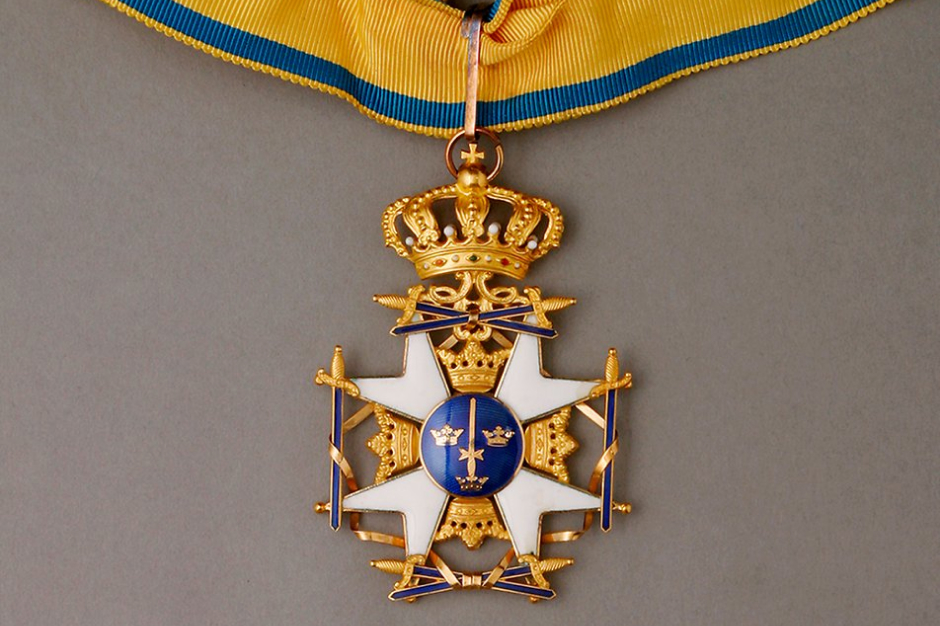
Commander of the Order of the Sword. Photo: Markku Koivumäki/Studio Kamera-Boden
The Royal Order of the Sword was instituted in 1748, and is conferred upon military personnel who have made personal endeavours for Sweden or for Swedish interests.
The insignia of the order is the decoration worn on a collar or on a yellow ribbon with blue edges.
The cross is a white-enamelled golden cross with a dark blue medallion bearing the three crowns of the order and an upright sword, crowned with a closed crown. Between the arms of the cross are open crowns.
The collar consists of alternating blue-enamelled antique helmets on pelte shields and swords with scabbards. The collar can be conferred upon foreign citizens as a special mark of honour.
For the two highest classes of the order, the star is also worn on the left side of the chest. The star is an eight-pointed silver cross, at the centre of which is a dark blue medallion bearing three crowns and an upright sword.
The classes are:
- Commander Grand Cross jpg, 10 MB.
- Commander, First Class jpg, 9 MB.
- Commander jpg, 490 kB.
- Knight, First Class jpg, 9 MB.
- Knight jpg, 9 MB.
The order includes the Cross of the Sword jpg, 8 MB., and the Medal of the Sword jpg, 15 MB., instituted in 1850.
The Order of the Sword for War or War-like Situations
As a special honour, which can only be conferred when Sweden is at war, King Gustav III instituted a rank of distinction in 1788, which was subsequently divided into two classes:
- Knight Grand Cross, First Class
- Knight Grand Cross
The special honour may be conferred on commanders who have distinguished themselves in a particularly outstanding manner of at least major general/rear admiral who has been a division general for the first class, or regimental officer who has been a battalion commander or officer serving on the staffs.
The Military Cross of the Order of the Sword
After the Second World War, the War Decorations Committee was appointed to review which awards Sweden should confer in the event of war. In the 1951 report of the War Decorations Committee, the introduction of the Military Cross of the Order of the Sword was proposed, accompanied by an illustration in the form of a watercolor painted by the designer Sven Sköld.
In the 1952 statutes, the Military Cross of the Order of the Sword was introduced in §49: The War Cross of the Order of the Sword may, regardless of previously received Swedish orders, be conferred on Swedish citizens belonging to the armed forces only when the kingdom is at war or on account of achievements during the war. /.../ The Military Cross of the Order of the Sword was neither manufactured nor awarded until the Order Reform came into effect in 1975, which put the Order of the Sword and its associated awards into retirement.
In 2021, the Merit Committee proposed a change to the Military Cross of the Order of the Sword, and under this name, it is listed under Section 29 in the Order Statutes pdf, 369 kB. that were established in 2023. The Military Cross of the Order of the Sword is the kingdom's decoration for bravery intended to be awarded for bravery in combat or a courageous act in battle and is awarded in three classes:
- The Military Cross of the Order of the Sword, First Class (gold) jpg, 13 MB.
- The Military Cross of the Order of the Sword, Second Class (silver) jpg, 12 MB.
- The Military Cross of the Order of the Sword, Third Class (brons) jpg, 13 MB.
The Royal Orders of Knighthood have commissioned the crosses from the Royal Court Supplier Sporrong AB. The Military Cross of the Order of the Sword has taken its final form in collaboration with the Swedish Armed Forces' heraldic artist, graphic designer Henrik Dahlström. Dahlström's version is based on Sven Sköld's image from 1951 and on the written description in the order's statutes from 1952. Finally, Sporrong AB manufactured the tool in which the crosses are cast.
Return of Orders
All orders shall be returned to the Royal Orders of Knighthood upon the death of the recipient. The order decoration, name and date of birth of the recipient shall be sent by registered post to Kungl. Maj:ts Orden.
The details of the person to whom acknowledgement of receipt of a returned order is to be sent must also be included. If desired, the Royal Orders of Knighthood can also send a picture, free of charge, of the returned order decoration along with the acknowledgement of receipt.